Open-source CLI · MIT · no account, ever
An agent saying it finished does not make it finished. dossier turns narrated agent work into a sealed evidence report your client can check — without an account, without trusting you, without trusting us.
build · render · verify — free forever · anchor — the one paid verb
// models got cheap. verification did not. the generation problem is solved; the trust problem is not.
The deliverable
A real dossier — rendered from canonical JSON, checkable by anyone with the free CLI or a browser. Verdict first, promise vs. proof second, failures and gaps included. Not a dashboard. Evidence.
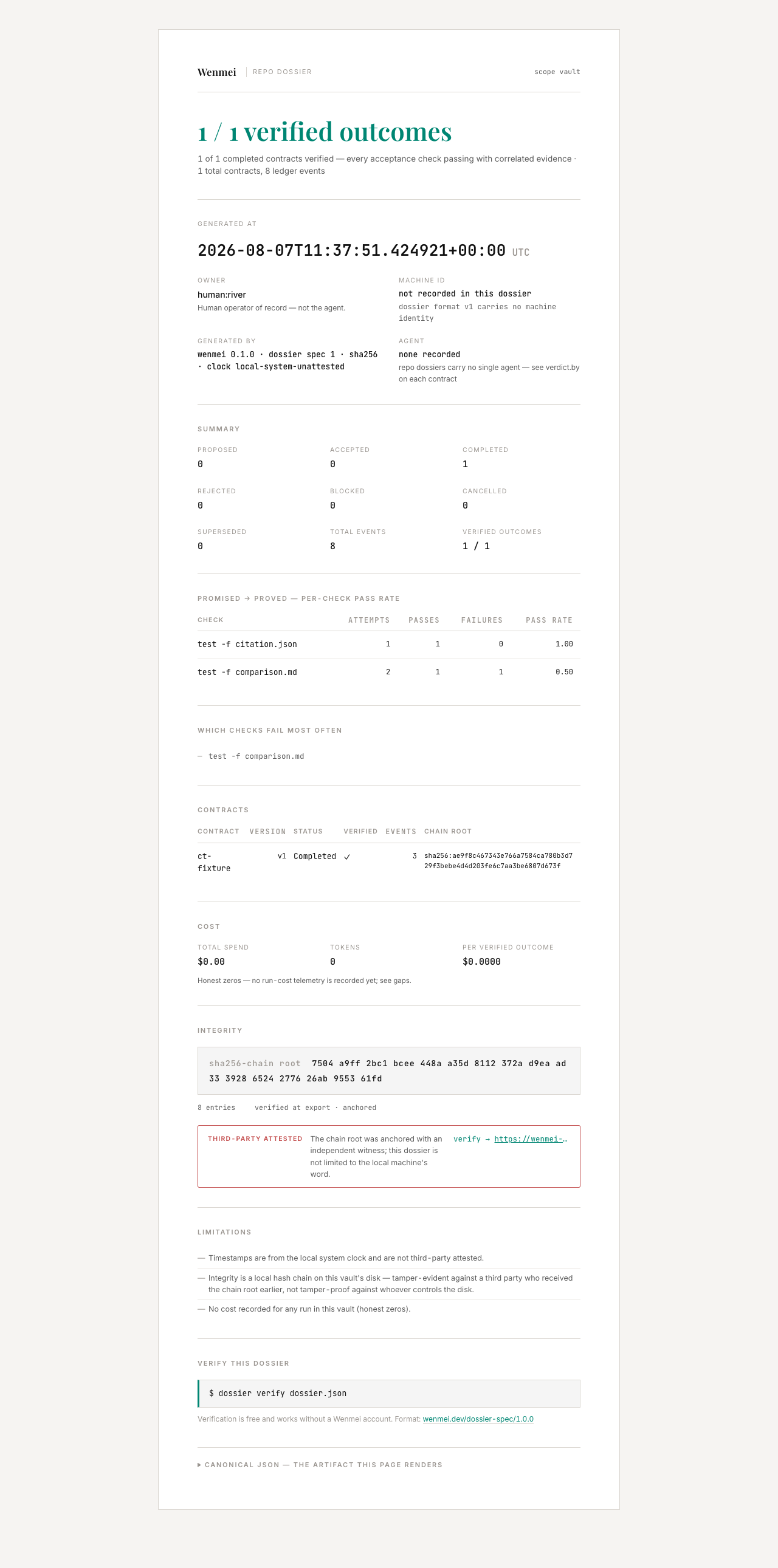
https://wenmei-witness-staging.shape02174.workers.dev/v/ax_90ffdb61
| Check | Attempts | Passes | Failures | Pass rate |
|---|---|---|---|---|
| test -f citation.json | 1 | 1 | 0 | 1.00 |
| test -f comparison.md | 2 | 1 | 1 | 0.50 |
Local proof, or local proof + witness — your choice.
How it works
Work is narrated as it happens — not reconstructed after. When it's done, the evidence becomes one canonical JSON anyone can check.
Owner of record — explicitly not the agent — plus a machine ID and local config. One command, no account, no email.
The agent's journal, run cards, and evidence live in plain files next to the work. Your disk, your format, openable forever.
Evidence becomes a chain root: one canonical JSON with rendered HTML and Markdown views. Free, local, offline — forever.
The chain root is signed by an independent witness at a point in time — everything before that moment becomes unforgeable, even by you.
Honesty as a feature
Buyers of evidence tooling are most repelled by vendors who overstate. Restraint is the sales asset — so the limits are printed on the artifact, not buried in a docs page.
The process record keeps attempt one's failure next to attempt two's pass. Gaps are listed verbatim in every export.
A check count never renders without its denominator. "3 passed" is marketing; "3 of 5" is evidence.
When cost isn't recorded, the dossier prints $0.00 and says "honest zeros — no run-cost telemetry recorded." It never guesses.
Dossiers live in .wenmei/dossiers/ as files you can open in any editor. We sell you a witness, not custody.
Your client recomputes the chain from the ledger and compares it to the claimed root. No account, no key, nothing trusted by name.
MIT-licensed, in an org repo — a verification standard carried by an org reads as infrastructure. Fork it; the witness is the moat, not the format.
"A dossier that only shows passes is marketing. A dossier that shows the failure and the fix is evidence."
Wenmei design principleWho it's for
You deliver work to a client or into a regulated environment, run coding agents locally, and need to demonstrate the work was verified — not just asserted.
You run long agent loops while you sleep. Morning you needs to know what actually happened — what passed, what failed, and what it cost per verified outcome.
If you need SSO, RBAC, cloud hosting, and a SOC 2 report, we're deliberately not your vendor yet — and we won't pretend otherwise.
Pricing
A local hash chain is an afternoon of work — charging for it would sell protection against the one adversary it doesn't stop: you. What can't be forged is a chain root witnessed off your machine. That's the service.
The complete, honest free tier. Not crippled — a free dossier is a real dossier.
Your chain is only as good as its witness. Anchoring makes everything before it unforgeable — even by you.
For teams whose clients and auditors need to check the work themselves.
Free allowance: 3 anchors/month with 90-day verify links — calibrated to demo, not to run a business. A founding cohort (capped at 1,000) gets a bounded lifetime allowance. Verification stays keyless forever, on every tier.
Start in thirty seconds
Install the CLI, run it in any repo where an agent did work, and send the dossier with the invoice. The recipient verifies it without an account — that's the whole pitch, and it's true today.
$ npm i -g @wenmei/dossier